
How Long Does Exterior Paint Last?
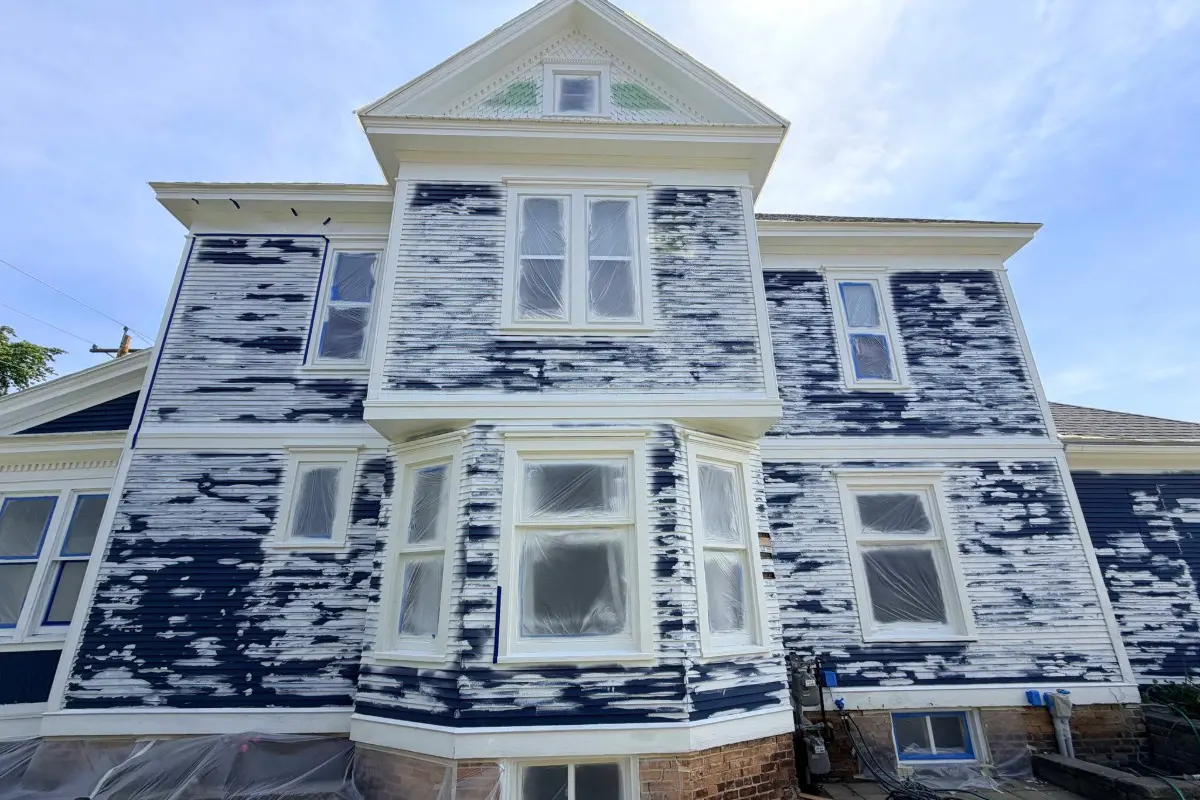
How long does exterior paint last? For homeowners across Granger, South Bend, and the rest of Michiana, the realistic range is five to ten years, but that number hides more than it reveals. Two nearly identical houses on the same street can need repainting years apart, and the difference almost always traces back to decisions made long before the first coat went on.
If you’re looking at faded siding or a few peeling spots near the trim, you’re really asking two questions: how much time is left, and what’s driving the clock. The answer matters because exterior paint is not decoration. It’s the barrier standing between our region’s freeze-thaw winters and the wood underneath.
This guide breaks down how long exterior paint lasts by siding type, what the local climate does to a finish, the factors that stretch a paint job toward ten years or cut it to four, and the warning signs that mean it’s time to act before a cosmetic problem becomes a structural one.
How Long Does Exterior Paint Last by Siding Type
The surface under the paint is the single biggest predictor of lifespan. A quality exterior coat generally holds for five to ten years, but the material it protects shifts that window considerably.
- Wood siding: three to seven years. Wood absorbs moisture and moves with every temperature swing, which stresses the film and opens the door to peeling.
- Fiber cement, such as Hardie board: ten to fifteen years. Its dimensional stability holds a finish far longer than natural wood.
- Aluminum siding: around five years before fading and chalking begin to show.
- Vinyl siding: roughly ten years when coated with paint formulated to flex along with it.
- Stucco: five to ten years, though it can crack if moisture works in behind the surface.
- Brick: ten to twenty years, but only when it was painted correctly and allowed to breathe.
Knowing your siding gives you a baseline. Everything after this either protects that number or quietly erodes it.
What Michiana Weather Does to a Paint Job
Northern Indiana and southwest Michigan sit in one of the harder environments in the country for exterior paint, which is why local homes rarely reach the top of those ranges without help. The daily and seasonal swings do the damage.
Freeze-thaw cycles are the biggest culprit. Water finds its way into hairline gaps, freezes overnight, expands, and pries the film loose a fraction at a time. After enough winters off Lake Michigan, that shows up as cracking and peeling, most often on the north and east faces that stay damp the longest.
Summer applies the opposite stress. Humidity keeps siding from drying fully, which encourages mildew and blistering, while direct sun breaks down the binders that hold pigment in place. South- and west-facing walls absorb the heaviest UV load and are almost always the first to fade.
Wind-driven rain adds another layer. Storms push moisture into the small gaps around windows, corner boards, and fascia, and those junctions are almost always where a finish starts to break down first. It’s rarely the broad, flat walls that fail early. It’s the edges, seams, and horizontal surfaces where water collects and lingers.
Older neighborhoods in South Bend and Mishawaka feel all of this most acutely. Many of those homes still wear their original wood siding, and wood plus freeze-thaw plus deferred maintenance is the exact recipe that turns a paint problem into a wood-rot problem.
The Factors That Decide Whether You Get 5 Years or 10
Climate sets the difficulty. These factors decide how well a finish stands up to it.
Surface Preparation
Prep is the difference between a coating that bonds and one that sits on the surface waiting to fail. Washing off dirt and mildew, scraping loose paint, sanding glossy areas, repairing damaged wood, and caulking gaps all have to happen before a brush touches the house.
A rushed job can look identical to a careful one on day one and start peeling within two or three years. Prep is the least visible part of the process and, by a wide margin, the most important to how long the result lasts.
Paint Quality and Number of Coats
Premium acrylic latex outlasts lower-grade paint because it stays flexible, expanding and contracting with the siding instead of cracking against it. Two finish coats over a proper primer consistently beat a single coat on durability and color retention, and high-exposure walls often justify an extra pass.
The money spent on quality materials up front is what buys the back half of that five-to-ten-year range. Cutting the material cost usually just moves the next repaint closer.
Color and Sun Exposure
Darker colors absorb more heat and fade faster than lighter ones, and on a sun-baked south wall the difference can be several years. That doesn’t mean a deep color is off the table. It means the exposure of each elevation should shape the plan, from the color itself to how many coats that wall receives.
Timing the Job: The Michiana Painting Season
When a house gets painted affects how long the finish holds nearly as much as how it gets painted. Paint needs stable temperatures and dry surfaces to cure into a durable film, and our region gives a limited window to work with.
Late spring through early fall is the reliable stretch. Daytime temperatures are warm enough for proper curing, and humidity is manageable enough for surfaces to dry between steps. Paint applied in cold, damp, or wildly fluctuating conditions never forms the bond it should, and it tends to fail early no matter how good the product is.
This is also why rushing a project into the shoulder seasons can backfire. A job squeezed in during a cold snap or a wet week can cost you years off the lifespan you paid for.
Repaint or Restain: What Weathered Wood Needs
Not every wood surface should be repainted. Decks, fences, and some natural-wood siding and trim are usually better served by stain, and choosing the wrong one shortens the life of the work.
Paint forms a film on top of the wood. It offers strong protection and full color, but once that film is breached, moisture gets underneath and pushes it off in sheets. Stain soaks into the grain instead. It won’t hide as much, and it generally needs refreshing more often, closer to every three to four years on an exposed deck, but it wears by fading rather than peeling, which makes recoating far simpler.
The practical rule for our climate: film-forming paint for most siding and trim, and a quality stain for horizontal wood that takes standing water and foot traffic. Matching the product to the surface is one of the quieter decisions that determines how long the finished work actually holds up.
Signs It’s Time to Repaint Your House Exterior
Your home will tell you when the finish is giving out. Watch for these:
- Fading or a chalky residue that rubs off on your hand, which signals the binder is breaking down.
- Peeling, flaking, or cracking, especially near trim, corners, and seams where movement concentrates.
- Bubbling or blistering, usually a sign that moisture is trapped beneath the film.
- Caulk that has pulled away from windows, doors, or joints, leaving gaps for water to enter.
- Bare wood, soft spots, or any area that stays damp. This is the most urgent sign of all.
A little fading is cosmetic and can wait for the right season. Exposed or soft wood is a different situation, and it rarely improves on its own.
Why Waiting Too Long Costs More Than a Repaint
Paint’s real job is protection, and once it fails, the clock starts on the material underneath. On wood siding and trim, an unprotected surface takes on water, and in a freeze-thaw climate that leads to rot faster than most homeowners expect.
At that point you’re no longer looking at a repaint. You’re looking at carpentry: replacing rotted boards, rebuilding trim, or restoring soffits and fascia before anything can be coated. A finish addressed on schedule is routine maintenance. A finish left until the wood is compromised becomes a repair project, and a far larger one.
That gap is the whole argument for repainting on the early signs rather than the late ones. A coat replaced before it fails carries the house through the next several winters and keeps a simple maintenance task from becoming a structural one.
Repaint on the Warning Signs, Not the Damage
So how long does exterior paint last on a Michiana home? Five to ten years, shaped by your siding, the local weather, and above all the quality of the prep and application. The homes that reach the top of that range are the ones that get the details right and repaint before the wood pays the price.
If your exterior is fading, peeling, or showing bare wood, the most useful next step is a straightforward, in-person look at where things actually stand. At Stahl Painting Company, we evaluate the condition of your siding and trim, handle any wood repair and carpentry in-house before we paint, and back our exterior work with a five-year workmanship warranty, the longest published exterior term in the Michiana market. As a locally owned, insured, and PCA-accredited team, we deliver a detailed written proposal on site, so you know the full scope and cost before any work starts. Call us at (574) 401-2570 to schedule your exterior assessment and protect your home ahead of the next freeze-thaw season.